June 12, 2014 at 8:00 am | Posted by Jon in Guitar Pickups
This is an interesting innovation, Dialtone Pickups have created a product that puts a resonant frequency & Q control on the actual pickups themselves. Now you might be thinking, what advantage does that have over a regular tone control? Well to be honest I’m not absolutely sure but obviously the controls are changing the way the pickups are working rather than affecting the signal after they have already captured the sound. As you can hear it has a dramatic impact on the tone and although it wasn’t demonstrated it does also mean that the tone can be set up for pickups individually so you can have a smooth bridge pickup sound but then a clear neck pickup sound with more treble which could then be blended using the pickup selector.
I look forward to seeing some more demos from this interesting product.
Update
Here is some more information from Dialtone Pickups:
“Pickups can generally be characterized by a resonant frequency and Q value. With typical pickups found in most guitars, these values are fixed by the passive electromagnetic design. Parameters such as the number of turns of wire, capacitance, magnet type, etc, all contribute to the sound produced. Dialtone Pickups use an active circuit that give independent control of the frequency and Q value. Control over these parameters coupled with a n option al gain control give tremendous creative possibilities to the artist.
My name is Pappy and I have a problem: I talk (and write) a lot in my reviews. I knew the review for the Taylor 816CE would be a long one, and I wanted to try some new things, so I recorded an audio version of the review for you to take with you on your run, or drive to work, or just to avoid the fatigue that would come from reading four pages of my review (link above). Another perk is being able to listen to the audio samples through better speakers (car) or better headphones. So go ahead and download the latest Guitar Noize podcast, hosted by me, and listen to the review. Also, be sure to click HERE to see the written review, all the awesome photos, and to see the videos that accompany the audio samples!
Is it that time of year again? Yep Joe Bonamassa has announced his latest studio album release, I think he may become the most recorded artist of all time at this rate! I know he didn’t release a studio album last year but he has of course been involved with another project with Beth Hart, they released their second album together “Seesaw” in 2013. Anyway, I can’t wait to hear “Different Shades Of Blue” which will be released in September, here’s the details.
Press Release
Different Shades Of Blues is Bonamassa’s first solo studio album since 2012’s Driving Towards The Daylight, which debuted at #2 on the Official UK Album Chart. It is also his first album to feature all-original material, penned by the man himself.
The resulting album is Bonamassa’s most accomplished work to date, It’s a blues record that explores the outer reaches and the many different sounds that shape the genre.
“It’s been a while since I’ve been involved in the writing on an entire album, “ says Bonamassa. “So I decided I wanted to make a completely original blues album. I’ve really had to push myself to make everything I do better than the last project. I know the fans expect it. And I feel like I owe it to the fans to give them an original record after all these years.”
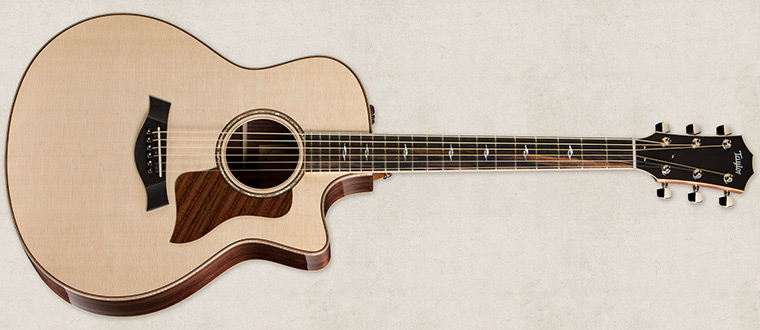
I told a friend of mine that Taylor Guitars sent me a freshly-made 816CE from their new generation and when I opened up the case, a new-guitar smell greeted me. The smell of cut wood, glue, and new finish. In a word, it smelled great.
“Smells like freedom,” he responded.
True, my friend is given to hyperbole, but I thought he was on to something with his comment. An acoustic guitar is freedom. What else could you use to disconnect from your electronic guitar world of guitars, amps, pedals, and all their required charging, instrument, or speaker cords and go to a place - any place of your choosing - and just play music. There’s no battery dying, there’s no electricity bill, there are no knobs to twist or gremlins in your signal to track down. It’s just you, your guitar, and the music you make.
The new Taylor 816CE provides the perfect playing partner in this regard. The 800 series is the most popular series in Taylor’s American-made line, which prompted questions when Taylor came out saying that they re-worked it. Just what would they change? What did they change? How would it impact one of the most popular guitars in the acoustic market?
Well, it turns out that Taylor Guitars refined the 800 series from the ground up with spectacular results. Andy Powers looked at the 800 series and went crazy adjusting it, but everything he did turned out to be an improvement and set a new standard that Taylor and almost any competitor can learn from and apply to their other guitars.
Regarding the acoustic tone, Powers first adjusted the wood thickness in each model. Some guitars need thicker wood than others, and he made sure that each size in the line received the appropriate thickness of wood to minimize weight, while maximizing strength and volume, and while this plays a large role in acoustic tone, where Powers made an even bigger impact was with the bracing. Each size in the 800-series received a different type of bracing that was designed to get the tone that Powers was after without changing any model depths with the exception of the Grand Orchestra model. Powers’ goal was to make the top and back work together, rather than just have the top be the star of the show, and the results speak for themselves.
For the particular guitarist out there, finish is always an issue, and it was issue with Powers as well. The standard thickness for Taylor guitars in the 500 series and above that is gloss, is about 6mils (.006″), but Powers, Bob Taylor, and co. reduced it down to a scant 3.5mils. It is a polyester finish and Powers knows you’re going to ask already. There’s a big set of beliefs regarding finish material, but Powers insists that it’s not what the finish is, but rather how thick it’s laid on.
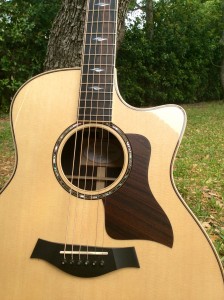
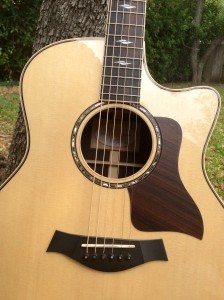
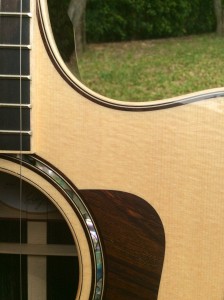
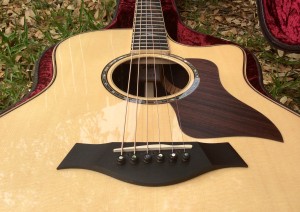
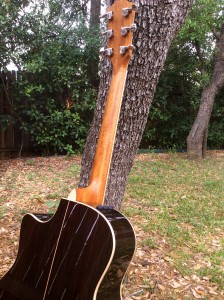
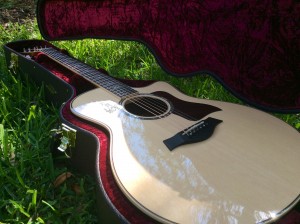
The guitar still features the traditional Sitka Spruce top with Indian Rosewood back and sides, and it looks amazing. The darkness of the rosewood clashes spectacularly with the spruce, but the maple binding (that also features a layer of rosewood in the purfling) separating the two finishes it off very nicely. Wood binding, by the way, is definitely my favorite type of binding. It looks like it belongs on the guitar rather than being placed on the guitar, which brings a serious sense of class to the guitar.
Speaking of aesthetics, you may have noticed the unusual pickguard. The pickguard is solid rosewood - not faux rosewood, but a solid piece of rosewood, with the grain of the wood angled to mirror normal strumming patterns. Originally they were designed with the grain going up and down so that it would be horizontal when hanging on your wall, but on a whim, one of the people cutting them changed the angle, and everyone agreed that it was the better option and not just aesthetically - since the wood grain will go with your strumming patterns, it will help disguise any pick marks you may inadvertently give your guitar.
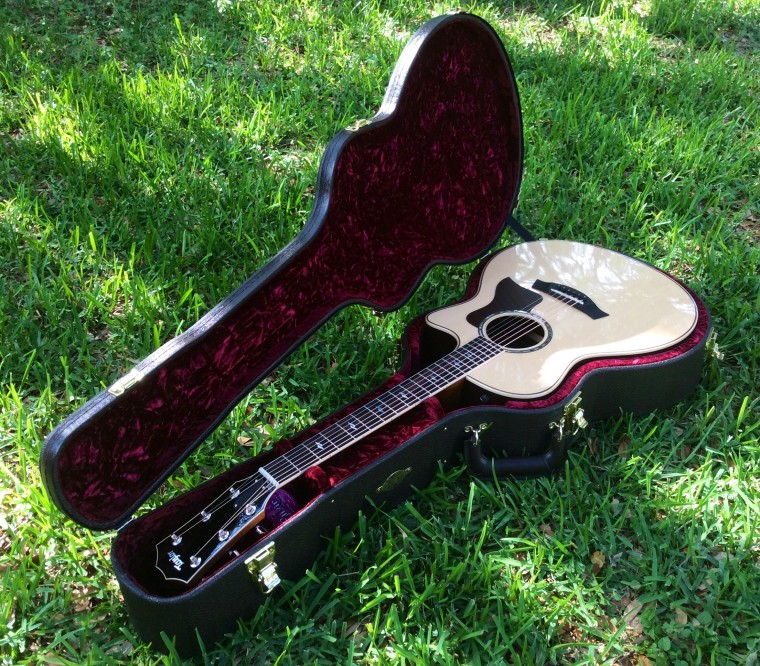
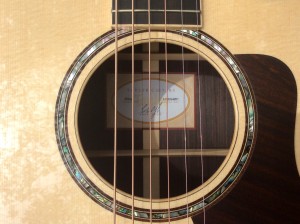
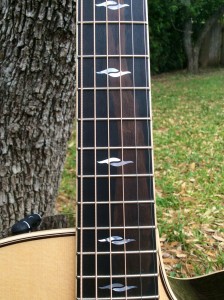
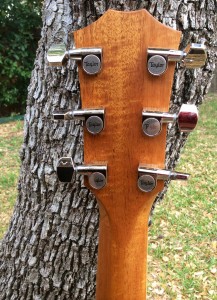
Other aesthetic choices of note are the new element inlays, designed to look like diamonds from a distance, an abalone/rosewood rosette, an ebony peghead overlay, and a “smokey ebony” fretboard. Bob Taylor and co. were distraught a few years ago at the amount of waste that came from ebony sawmills when they found that very few trees produce the solid black ebony we know, but that was the only ebony anyone was interested in buying, so all the rest was treated as trash. Taylor’s thought was that in this day and age, with our trees going away very quickly, it’s best to have ebony with character now and forever rather than have perfect ebony now and for the next, we’ll say five years, and then no more ebony. Ever. I couldn’t support this idea more. For one thing, perfect-looking things don’t appeal to me nearly as much as things with character - things with identity. They look hand-made and organic. I’m a big fan of that look, and the ebony fretboard on my review 816CE has lovely streaks of light brown going down the length of it that I loved from the moment I opened the case. Is it “perfect” in the traditional sense? No. But it’s perfect for me.
Going back to freedom for a second, yes, being able to disconnect from your electronic world is certainly a good thing. It gets you alone with your music and that is a valuable tool for development and songwriting. And having an acoustic that sounds good is dreadfully important because it makes you want to play more (and the more you play, the better you and the guitar will sound). But these things alone are not freedom. Freedom is not just the ability to disconnect, but the ability to connect when you want to, as well. Acoustic guitars and electricity have been at odds for a while now, and plugging one in can be a big challenge in some cases, but the 816CE was engineered to be a player’s best friend.
For one thing, the Expression System that Taylor guitars have been using for years now was redeveloped specifically for the 800-series with the ES2 system, moving the Piezo crystals from under the saddle, where they sit crushed under 60 pounds of force, to behind the saddles where they are under about three pounds of force. This is a drastic difference that makes for a more natural sound when you plug the guitar in and not at all what you would normally associate with the bright, brash Piezo crystals you’ve heard in the past. The result is such a great change that they’re even implementing the same swap on all Taylor guitars from the 500-series up.
Plugging the guitar in is as easy as plugging a cord into the input jack that doubles as a strap pin. The three control knobs still act as the controls and still lack labels, but that’s more than fine with me. There’s only three knobs to memorize and labels would be a detriment to the aesthetics.
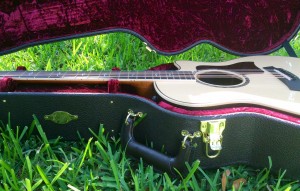
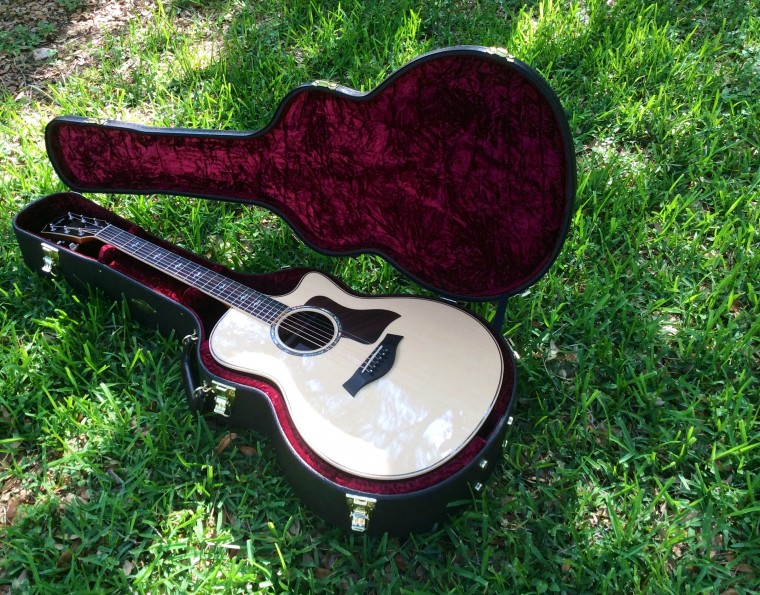
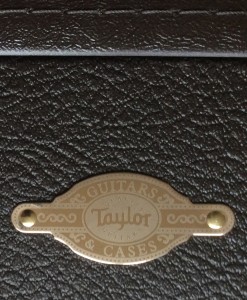
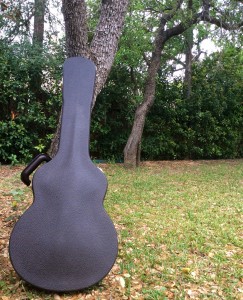
Lastly, the guitar comes in a case that was made for that specific guitar shape. In Bob Taylor’s book Guitar Lessons “The case was branded, and styled so that it was beautiful and recognizable. It wasn’t a purchased generic case where ‘one size fits all,’ which is another way of saying, ‘one size fits nothing.’ They knew that their case was for their guitar, one for every shape we offered, and that translated into them feeling like we made it for them!” Taylor’s not exaggerating: Their cases are beautiful and functional. They’re strong, with thick padding on the handle (that isn’t stationary so your wrist won’t bother you nearly as much as with standard cases), and a classy brown color. I have long said that Taylor cases are my favorite hard-shell cases.
So now that we’ve talked all about the refinement of the guitar, we’re left with the minor issue of the sound. You can refine everything for as long as you like, but in the end it all comes down to the question “How does it sound?”
Well, in a word, it sounds awesome. Taylor’s most popular shape is the Grand Auditorium (models ending with “14”), but the company sent me the slightly larger (Grand Symphony size) 816CE for review. I reviewed a 616CE in the past and found that the brightness of the maple back and sides balanced really well with the extra size (and the extra bass that comes with it), so I wasn’t upset or anything when I was told what was coming to me. It arrived and I played the first chord and noted right away that bass presence was definitely there. Mids and highs were still present, but there was a nice, thick bass to everything I played. The bass permeated everything I played, and it became something I started to really enjoy. Jazz chords sounded thick and full, I never once thought I would sound better if a bass player was backing me up, and I fell into writing material using the low E as a drone string, letting it ring out as I moved around on the higher five strings.
For fingerpicking, there was no such thing as harsh highs and the bass didn’t drown out details. The extra bass leant a great deal of “oomph,” to power chords and punk playing. Even strumming open chords sounded better with the additional bass. If you don’t know which size is best for you and you think the Grand Auditorium is the one because that’s what everyone else is getting, you should definitely check out the Grand Symphony size (ending with “16”) and see if it’s a better fit for you tonally. I know that I was convinced that the GA size was THE size for me until a Taylor rep watched me play, pulled down the 616CE and let me strum some chords, and that was when I became a big, big Taylor fan. The difference in tone has a big impact without being so drastic it’s scary, and the size difference is not so much that you would worry about it.
Just… Trust me, and check out the GS size next time you get a chance.
In fact, if you need a bit more convincing, check out these videos where I play open chords, hybrid picking/Fingerstyle with the addition of some power chords, and power chords with a drone string. I recorded the videos and stripped away the camera’s audio signals, replacing them with the audio that was being recorded simultaneously into two channels in GarageBand. One channel is the Taylor’s electrics through an IK Multimedia Stealth Pedal into GarageBand’s stock preset after clicking off reverb and echo. The other channel is the Taylor’s acoustics recorded through a Blue Snowball. I panned the two tracks slightly left and right so if you listen to this in your car or through headphones, you can hear the difference, but also how they sound together.
Here is the video demonstrating open chords:
Here is the video demonstrating hybrid picking with some power chords:
Here is the video with power chords and a drone string:
Yes, freedom can be showcased in many ways, but since I’m an obsessed guitarist, most things begin and end in the guitar world, and there is no better example of freedom in highs my world than the Taylor 816CE. It’s there to play acoustic outside on the porch or under a tree, or just away from everyone else, but it gives you the freedom to take the exact same guitar into the studio and plug it in with no hassles and record right away. It can handle what you give it to handle, and it sings beautifully always putting you in the best light possible (while looking pretty rad too).
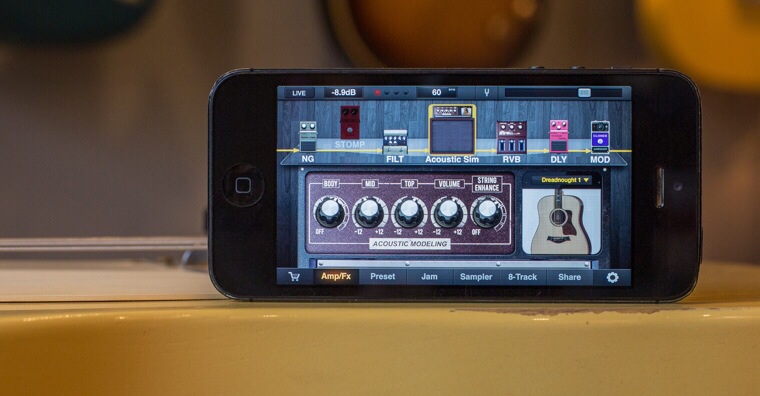
San Diego, CA (Jun 10, 2014) — Positive Grid updates its flagship guitar and bass multi-effects app JamUp with major new features. New JamUp includes three new Expansion Packs: Vintage Effects, Acoustic Pro, and Gurus Amps®, built-in BIAS integration with free factory amp, new designed graphic interface, comprehensive preset manager, and new JamUp Store.
New JamUp represents the best solution for the mobile musicians. In conjunction with a high quality guitar interface for iOS the iPad or iPhone, it delivers anything a guitar or bass player could dream of in terms of an incredible selection of amp tones, effects and programmability for any situations: rehearsing at home, backstage, recording and live performance.
“New JamUp is the celebration of three years since the original JamUp hit the market, so we created a full blown new version”, said Jaime Ruchman, Marketing Manager at Positive Grid. “Musicians can now revive the classic tone and feel of vintage amps and effects, and this time we were able to collaborate with Gurus Amps to create unique sounding amp tones. New JamUp proves how easy, professional, and fun it can be when integrated as an endless platform”.
New Features Overview:
Vintage Effects Expansion Pack
Features 8 most vaunted and valuable guitar effects revisiting the times when the modern guitar tone was born, whether for innovation, inspiration, sound, sheer popularity, or all of the above, each unit can make the perfect cut! The included models are based on: *Dallas Rangemaster® Treble Booster, *Electro Harmonix® Small Clone, Big Muff, Knockout Attack EQ, *Boss® DM-2 Analog Delay, *Voodoo Labs® Vibe, *Fulltone® OCD Overdrive and *Demeter Tremulator Tremolo.
Introducing the unique acoustic imaging technology: Acoustic Expansion Pack
Featuring Positive Grid’s acoustic imaging technology that restores a studio-miked sound to a undersaddle or soundhole pickup. This is the complete acoustic tone solution for both acoustic and electric guitar players. It comes with the new and premium Acoustic Simulator that any electric guitar into realistic acoustic tone. The included models are: Acoustic Imaging, Acoustic Pro Simulator, Acoustic EQ and Acoustic Reverb.
Gurus Amp Expansion Pack
Positive Grid partnered with Cicognani Engineering who developed 3 extremely powerful Amps. The Guru Amps Models provide all the juice needed to fuel the guitar tone with sweet’n’deep crunch styled sound. All from a light squeeze of overdrive to full on classic distortion and everything in between. The included amp models are based on Gurus Naked amplifier’s Sexy Channel, Crunch Channel and Lead Channel. We choose to collaborate with Gurus Amps because this Italian company made the World first Tube Amplifiers specifically designed for live use of external digital devices running emulation software. Thanks to their innovative iChannel®, Gurus Amps can express the best of both worlds, analog and digital together.
BIAS Custom Amp
JamUp now comes with free Positive Grid’s BIAS amp; users can taste the powerful BIAS tone inside JamUp and go deeply into full customization with the optional BIAS-app on iPhone and iPad, bringing the amp modeling world to a whole new level.
New graphics, preset manager, Dropbox support and more
The redesigned graphical interface makes JamUp look even better. JamUp adds a useful and intuitive preset manager to order, edit and delete presets, and users can now backup presets via Dropbox.
Update is for both JamUp XT (free) and JamUp Pro XT ($19.99) and they are available for immediate download at the iTunes App Store. Both apps offer the same sound engine, and both are compatible with the JamUp Plug ($19.99), JamUp Plug HD ($99.99) and most iOS guitar audio interfaces.
June 10, 2014 at 9:00 am | Posted by Jon in Guitar Effects
This is interesting, TC Electronic are known for building special runs of modified pedals for certain retailers such as Guitar Center and Pro Guitar Shop and PGS have, in the past collaborated with Empress Effects to create the amazing Vintage Modified Superdelay so they certainly know their vintage delay sounds. The TC Electronic Flashback X4 is a fantastic delay pedal that covers a wide spectrum of delay types but what the guys at Pro Guitar Shop wanted to do was to create a version that focusses on vintage delays called the TC Electronic Alter Ego X4.
Starting with the acquisition of several vintage delay units three years ago, we undertook the Alter Ego X4 project in the most organic way possible—deriving sounds from the actual units to be modeled. Several classic units are represented within the newest Alter Ego: From classic units such as the Binson Echorec and the Roland RE-301 Space Echo to more obscure pieces such as the Watkins Copicat and the Tel-Ray Super Organ Tone, every flavor of echo is represented from every era of the delay continuum.
Settings:
Binson Echorec 1
Binson Echorec 2
Electro-Harmonix blue face Deluxe Memory Man (chorus)
Electro-Harmonix blue face Deluxe Memory Man (vibrato)
Tel-Ray Super Organ Tone
TC Electronic 2290 with modulation
Reverse delay with modulation
Boss DM-2
Watkins Copicat
Maestro EP-2 Echoplex
Electro Harmonix Echoflanger (think The Police – “Walking on the Moon”)
Roland RE-201 Space Echo
Aside from the internal changes, PGS also worked with TC Electronic to give the exterior a completely original look which not only differentiates nicely from the original Flashback X4 but also has a very vintage look and feel to it. In fact, sorry TC, but I love the look of this pedal compared to the fairly boring look of the Flashback X4. I know looks aren’t everything but it certainly makes me want it more and those vintage delays sound fantastic. Great work TC Electronic and Pro Guitar Shop!
Gearphoria, the free,did I say free? Indeed I did, an excellent guitar mag which I have contributed to in the past and surprised myself by sounding all professional, is moving from a quarterly to bi-monthly format. This is great news, Blake and Holly do an excellent job each issue with features, reviews and all things boutique guitar.
Since the transformation from effects blog ʻWhatʼs That Dude Play?ʼ to a
quarterly e-mag, Gearphoria has increased in popularity and set the standard for small
builder coverage in the robust boutique guitar-centric MI market.
“Support for Gearphoria has been phenomenal and continues to grow,” explained Blake
Wright, Gearphoria publisher and editor-in-chief. “By moving to bimonthly delivery, we
will be better positioned as a timely news source as well as give us the opportunity to
expand our breadth of coverage. It also creates two additional issues per year to tell the
stories we want to tell.”
Along with the increased frequency, Gearphoria will also undergo a redesign that aims
to improve readability as well as better capitalize on the publicationʼs digital platform.
The magazine will continue to be free to read, and include all of the content it has come
to be known for… insightful columns on the gear of yesterday and today, exclusive and
in-depth features, builder profiles, artist interviews, shop tours, gear reviews and more.
Based in Houston, Texas, Gearphoria is a publication of WrightSide Media.
One of the most popular concerns I’ve seen about buying guitars has always been how well a guitar is balanced. Guitar balance is a big deal, but the majority of people asking are just concerned with how much their guitar is going to slide around uncomfortably on their shirt and these people are almost always using slippery nylon straps. A pickup builder, Clint Searcy, was talking about it to me and asked why people don’t just buy a good leather strap and call it good?
That’s a good question. Nylon may be an affordable material, but it’s slick. Leather isn’t nearly as unctuous, but it does come at a price. Namely, its price. Leather straps are often pricey alternatives to five dollar straps that a lot of guitarists don’t see a ton of need for, but experienced guitarists know leather is strong, durable, and stable. It’s an upgrade that is worth pursuing.
And there are certainly guitar straps out there that won’t cost you too much, like the straps from Tempest Leather. Tempest sent me two straps of my choosing to review, and I picked the “I’m in Stitches,” and the “Settle the Score,” straps, both from the Clooney line - which seems to be the traditionally classy side of Tempest’s offerings, though they have more wild designs out there if that’s your preference.
The “I’m in Stitches,” strap was ordered with a 3″ width, rather than your average 2″ width (which is also available if you prefer) with a suede back, adding further to the “stick-to-you” factor. I generally like wider straps because they spread the weight out a bit more and are generally more comfortable. The edges of the Stitches strap are smooth, but not overwhelmingly so, retaining a big “natural,” feeling.
The “Settle the Score,” strap is also from the Clooney line and it features cored leather which are just as much about function as they are about form. By scoring the leather, you increase it’s flexibility, which means it feels nicely worn-in the first time you put it on because it contours itself to your body immediately. It’s a very comfortable strap. The edges are a bit more rough than the Stitches strap, but not distractingly so, and I don’t mind. Leather is, by nature, rough and I never trust leather that is either perfect-looking or ridiculously smooth.
Tempest uses Italian leather on their straps and their straps feature three pin holes (one on one end, two on the other) so you can start to determine your strap’s length. Straps generally come in two sizes, normal (45-56″) and extra long, which adds 5″ to the strap length. The bottom pin hole would probably be where most people play comfortably, but I prefer my straps to be a bit shorter because I like my guitars to be higher on me. Because of this, I prefer to use the pin hole above and still set it to its shortest length and it gets super close to my preferred length.
Overall, the straps are definitely worth considering when you’re ready to upgrade your guitar and your playing experience. Not having your guitar slide around on you all gig long makes it a worthy purchase and the fact that these straps add beauty to the mix with very classy options makes Tempest a very good choice. The “I’m in Stitches,” retails for $53.00 and the “Settle the Score,” retails for $45.00.
For more information, or to purchase your own, click HERE!
June 8, 2014 at 7:35 pm | Posted by Jon in Guitar Effects
Well this kind of came out of the blue, with no teasers anywhere to be seen at NAMM 2014 or MusikMesse 2014 (unless I missed it?), Fractal Audio have created a new forum thread called Coming Soon and calmly dropped a photo of the Fractal Audio FX-8 Multi-Effects Pedalboard. When pressed for more information by forum members they responded with:
“Just effects. Specifically designed for 4CM with dedicated pre- and post- paths. Up to 8 simultaneous effects. Any number assignable pre/post. Any combination of series or parallel routing. Two expression pedal inputs, four relay outputs. USB for remote editing with free FX8-Edit software. Silent Switch technology from the MFC Mark III. True Bypass. Internal, universal power supply.”
“Does it channel switch an amplifier? - Yes”
“Is there anything it can do that AXE FX II cannot? Are there any thing new that is not in the axe fx II? - True bypass and relay outputs. Longer Looper time. Other than that it’s most of the fx from the Axe-Fx II in a floor package.”
June 8, 2014 at 5:08 am | Posted by pappy in Pappy, Reviews
by Pappy
Being on a dark stage, it can be difficult to see your knobs and, if you’re the kind of guitarist that uses your knobs in your songs, that can be a big problem. Some companies have tried to fix this by using knobs with glow-in-the-dark lines, but these are almost always on fragile, plastic knobs.
Luckily Luminlay, a company that has until now been selling replacement fretboard and side inlays that glow in the dark has started offering aftermarket knobs - metal knobs - and these knobs glow in the dark and not in the “one line is all you need,” kind of way, but with a ring of glow-in-the-dark numbers that are big enough to be seen on stage, shining in their brilliance.
Luminlay sent me the MA19G-BK, which is a black plated knob with green glowing numbers, and right away you can feel the durability in the knob’s heft. While you may initially think that the glow ring is made from plastic, you’d be wrong. It’s a ring of metal that’s been engraved and then filled with glow-in-the-dark paint.
At 1,900 yen (about 18.00 US), these knobs are on the pricey end, but they’re well worth the cost. Judging by the glow strength (very bright), duration (about 20 minutes without any recharging, but it’s worth noting that stage lights will recharge the paint so you will probably have knobs that glow for as long as you need) and general knob quality, I would recommend these to any guitarist who wants to be able to see their knob’s position(s) at any time, or just to spice up their guitar’s aesthetics! It’s money well-spent to add a unique and functional twist to your guitar.





 So now that we’ve talked all about the refinement of the guitar, we’re left with the minor issue of the sound. You can refine everything for as long as you like, but in the end it all comes down to the question “How does it sound?”